Last updated November 25, 2026


Free roof inspection with deck photos before we talk money - GAF and Owens Corning certified installation
Roofing Warning Signs: A Tacoma Homeowner’s Reference Guide
The most expensive roofing failures we see around Tacoma don’t announce themselves with water pouring through a ceiling. They start quietly: a soft spot in the decking hidden under two layers of shingles and soaked insulation, or a granule pattern thinning in a way that looks like nothing at all from the driveway. By the time water reaches the living room, the damage has usually been building for a season or two. This guide is a reference, not a checklist. It walks you through the exterior and interior signs worth knowing, explains what each one actually tells you about remaining life in Tacoma’s wet climate, and gives you a clear framework for deciding what to monitor and what to call in this week.
Quick Answer
In Tacoma, the roofing warning signs that matter most are granule loss visible as dark patches on shingles, cupping rather than curling at the shingle edges, moss growing in distinct bands or patches, interior staining that darkens over days rather than staying faint, and staining around pipe boots and valleys. Each one signals a different stage of failure, and most are worth a professional assessment rather than waiting until a leak appears inside the house.
Styles & brands we work with
- Architectural shingles
- Metal roofing
- Tile roofing
- GAF
- Owens Corning
- Flat & low-slope
Table of Contents
- Exterior Warning Signs You Can See From the Ground
- Shingle Cupping vs. Curling: What Each Means
- Why Moss and Algae Are a Symptom, Not an Aesthetic Problem
- Interior Warning Signs and How to Read Them
- Condensation Staining vs. Active Leak Staining
- Flashing Warning Signs: Valleys and Pipe Boots
- A Triage Framework: Monitor, Budget, or Call This Week
- When Warning Signs Mean a Full Roof Assessment
Exterior Warning Signs You Can See From the Ground
Most of what you need to know about a Tacoma roof is visible without ever climbing up. The trick is knowing which details to read and which ones homeowners consistently misdiagnose. Granule loss, for example, is often read as “normal wear” when the pattern of loss is telling you something specific about how many seasons the shingle has left. Shingle edges look roughly the same from thirty feet whether they’re slightly worn or on the edge of failure, so you need to know what to look for.
Here are the exterior signals worth watching, in roughly the order they tend to appear in Tacoma’s climate:
- Bare or darkened patches on shingles where granules have washed or weathered off. Compare the field of the roof to the shaded section under an eave; if the two look significantly different in texture, granule loss is underway.
- Tab gaps and lifted edges that show up as dark seams between shingles. A few here and there are usually cosmetic. Long rows of lifted tabs suggest adhesive failure, which lets wind-driven rain work underneath.
- Sagging along the roofline that you can spot by sighting along the ridge. A slight dip or a wave in the plane of the roof usually means either decking that’s been wet on and off for a while or an underlying framing issue.
- Debris accumulation in valleys where needles and leaves hold moisture against the shingle surface. In Tacoma’s Douglas fir and cedar cover, valley debris is one of the most common causes of hidden premature failure.
- Lifted or wavy fascia and soffit boards at the eaves, which often signal water tracking behind the gutter line. This is one of the earliest exterior signs and often gets attributed to paint failure.
- Gutter granules visible as sandy grit piled at the bottom of a downspout outflow. Granules that make it to the ground have usually travelled a long way from the same shingles that are thinning on top.
Walk the perimeter of the house once a season and again after any stretch of wind. You don’t need binoculars. You need to know which of these is new compared to last time. A roofer can look at any of these patterns and give you an honest read on how much roof life remains, whether the right path is monitoring and budgeting, or a roof replacement before another wet season sets in.
Shingle Cupping vs. Curling: What Each Means
Homeowners often use “curling” for both, but cupping and curling are different failure modes with different causes. Cupping is when the center of a shingle tab lifts while the edges stay down, giving the roof a concave, bowl-like texture. Curling is when the edges lift while the center stays down. Both reduce remaining life, but the causes point in different directions, and that matters for what a proper fix actually is.
Cupping usually points to moisture getting underneath the shingle layer. The mat absorbs water, swells on the underside, and lifts in the middle. On asphalt shingles, cupping is often the first sign that the underlayment has failed somewhere nearby. On an older Tacoma roof with a lot of shade and organic debris, cupping often appears in a pattern tied to the tree cover, not the roofline, which is a useful clue.
Curling at the shingle edges is more often tied to age: the asphalt in the shingle has lost its oils and the mat has shrunk. It’s also common where attic ventilation is inadequate, cooking the shingle from below. If you have curling on the sunny south slope and no cupping anywhere else, ventilation and age are your likely culprits. If you have cupping under tree cover in the north slope, moisture is more likely behind it.
A quick practical framework:
- Stand back so you can see a full slope at a low angle. Cupping shows as horizontal ripples, not vertical.
- Check the direction the lift goes on several shingles. If most tabs lift in the center, that’s cupping. If most lift at the edge, that’s curling.
- Note where each appears. Cupping concentrated under shade is usually a moisture retention story. Curling across a sun-facing plane usually isn’t.
- Look at the granules near the cupped area. If they’re gone, the same wet cycle that caused the cupping is already wearing the surface.
Whichever pattern you’re seeing, an in-person read is worth it. When a full roof assessment is done, a good contractor can walk you through the trade-offs of asphalt, shingle roofing, tile, or metal based on your home, not on what’s sitting in a specific warehouse.
Why Moss and Algae Are a Symptom, Not an Aesthetic Problem
Moss is often treated as a Tacoma cosmetic problem, something to spray with a store-bought product once a year. That misses what moss is actually telling you. Moss only thrives where moisture lingers on the roofing surface long enough for spores to establish. If it’s growing in a specific pattern, that pattern is a map of where water on your roof doesn’t drain freely or dry quickly. The moss is a symptom of moisture retention, and the moisture retention is what shortens roof life.
Read the growth pattern before you treat the moss:
- Moss in the valleys. Near certain: debris is slowing drainage. The moss is telling you the valley needs to be cleared and probably the flashing inspected.
- Moss under tree cover and in north-facing shade. Expectation: shingles are staying damp for extended periods. The moss may not be a sign of failure yet, but it accelerates the timeline.
- Moss in streaks or bands following a specific path. Usually a sign of a slow drainage issue behind or beneath the moss, not just surface growth.
- Moss growing in the granular surface itself, densely. A denser growth pattern suggests shingles that are already worn enough to hold moisture. In this case, the moss and the shingle condition are the same problem.
Algae appears as dark streaking down a slope, usually from the ridge. Algae streaking is mostly a cosmetic issue on its own, but on older roofs it competes with the granules for the surface, and it correlates with surfaces that are staying wet longer than they should. Granule-coated shingles with algae-resistant surface technology (most modern shingle lines from GAF and CertainTeed include this) cut down on streaking, though no shingle eliminates shade dampness.
Here’s the fix most homeowners don’t want to hear: spraying moss off without addressing the reason it appeared means it comes back. Clearing debris, checking drainage, and making sure the shingles underneath are sound is the actual fix. If the moss extends past what a simple cleaning can address, a proper inspection is worth the time.
Interior Warning Signs and How to Read Them
Interior warning signs matter most when you know how to read them as patterns, not as isolated stains. A ceiling stain in Tacoma might mean an active leak, condensation from attic humidity, or an old issue that’s already dried and needs no action beyond monitoring. The pattern is what tells them apart.
What to look for inside the house:
- Ceiling stains that darken over days. This is the strongest single signal of an active leak. If a stain is visibly darker today than it was last week, moisture is arriving fast enough to matter.
- Multiple stains along a straight line. Usually water running along a rafter or a piece of strapping from a leak farther upslope. The stain isn’t where the leak is; the running line points to it.
- Stains around a chimney or a vent. Point to flashing failure at penetrations, not a general roof problem.
- Peeling paint or bubbling plaster on upper-floor ceilings. Often precedes visible staining by a season or two. Worth investigating before the water works its way to the paint line.
- Musty smells in upper rooms. Suggest prolonged moisture, even in the absence of stains.
- Daylight visible through the roof decking from inside the attic. Means you can see through the shingle layer, which means water can too.
You’ll get the clearest read during a rainy week, not after a dry stretch. Tacoma’s fall-through-spring wet season is the best time to check because active leaks show up when they’re actually running. If you’re seeing any of these in your home and you’d rather not diagnose them yourself, that’s exactly the reason a professional assessment exists. Roofing work at height and above live wiring is not a do-it-yourself domain, and we’d rather see you call than take a risk on a ladder in the rain. Call (253) 295-5163. We answer 24/7. Fast dispatch from 7am to 7pm, Sunday through Friday.
Condensation Staining vs. Active Leak Staining
This is the most common misdiagnosis we run into on Tacoma roofs. Condensation staining and active leak staining look similar at a glance, but they’re caused by different things and demand different responses. Confusing one for the other leads either to an unnecessary repair or, worse, to a real leak that gets ignored because the homeowner assumed it was just attic humidity.
The key differences:
- Condensation staining typically appears as a faint, uniform discoloration across a wide area, often near the ridge or along the underside of the roof deck. It doesn’t darken sharply over days. It often comes with frost on the nail tips in cold weather.
- Active leak staining grows from a point or a line and darkens over days. It spreads. It often has a brownish ring at the edge of the wet area. It comes with soaked insulation and sometimes visible dripping.
- Condensation on a Tacoma roof usually stems from inadequate attic ventilation and warm, moist interior air meeting a cold deck in winter. It’s more common on roofs with limited ridge or soffit venting, and it can build up to the point of soaking insulation without ever showing an active drip.
- Leak staining almost always traces back to a specific roof detail: a valley, a pipe boot, a chimney flashing, a nail pop, or a lifted shingle. It shows up in a distinct location, not as a broad haze.
Reading a stain:
- Look at the shape. Stains that are roughly circular or run along a line are more likely active leaks. Uniform, hazy discoloration across a wide area is more likely condensation.
- Check the timing. If it darkens after rain, it’s a leak. If it darkens after a cold snap, it’s more likely condensation.
- Look at the attic. Soaked insulation directly below the stained area and a wet deck point to a leak. Frost on nail tips and a dry deck point to ventilation.
- Check the drip edge. Dripping during rain confirms a leak. No drip through a long wet stretch argues for condensation.
Ventilation problems are a roofing concern, not a separate service. Fixing them usually means looking at the roof as a system: venting, flashing, and the shingle layer all need to be considered together. If a full new roof installation ends up being the right path, proper attic ventilation is part of what a good installation includes, not an add-on.
Flashing Warning Signs: Valleys and Pipe Boots
Valleys and pipe boots cause the majority of leak calls we get in Tacoma. They’re also the parts of the roof that get inspected the least, because they’re hard to see from the ground and easy to miss during a quick pass. Knowing their failure signs before water gets inside the structure is the single most useful roofing skill a homeowner can develop.
Warning signs around valleys:
- Debris build-up at the valley center. Needles, leaves, and grit slow the water that funnels through the valley, and slowed water finds weak spots.
- Visible lifting or separation of the metal valley flashing from the shingle edges. Any gap is a way in.
- Rust, pitting, or staining on the valley metal. Points to years of wet contact and possibly the start of a penetration.
- Shingle tabs that don’t lie flat along the valley line. Water finds these first.
Warning signs around pipe boots and other penetrations:
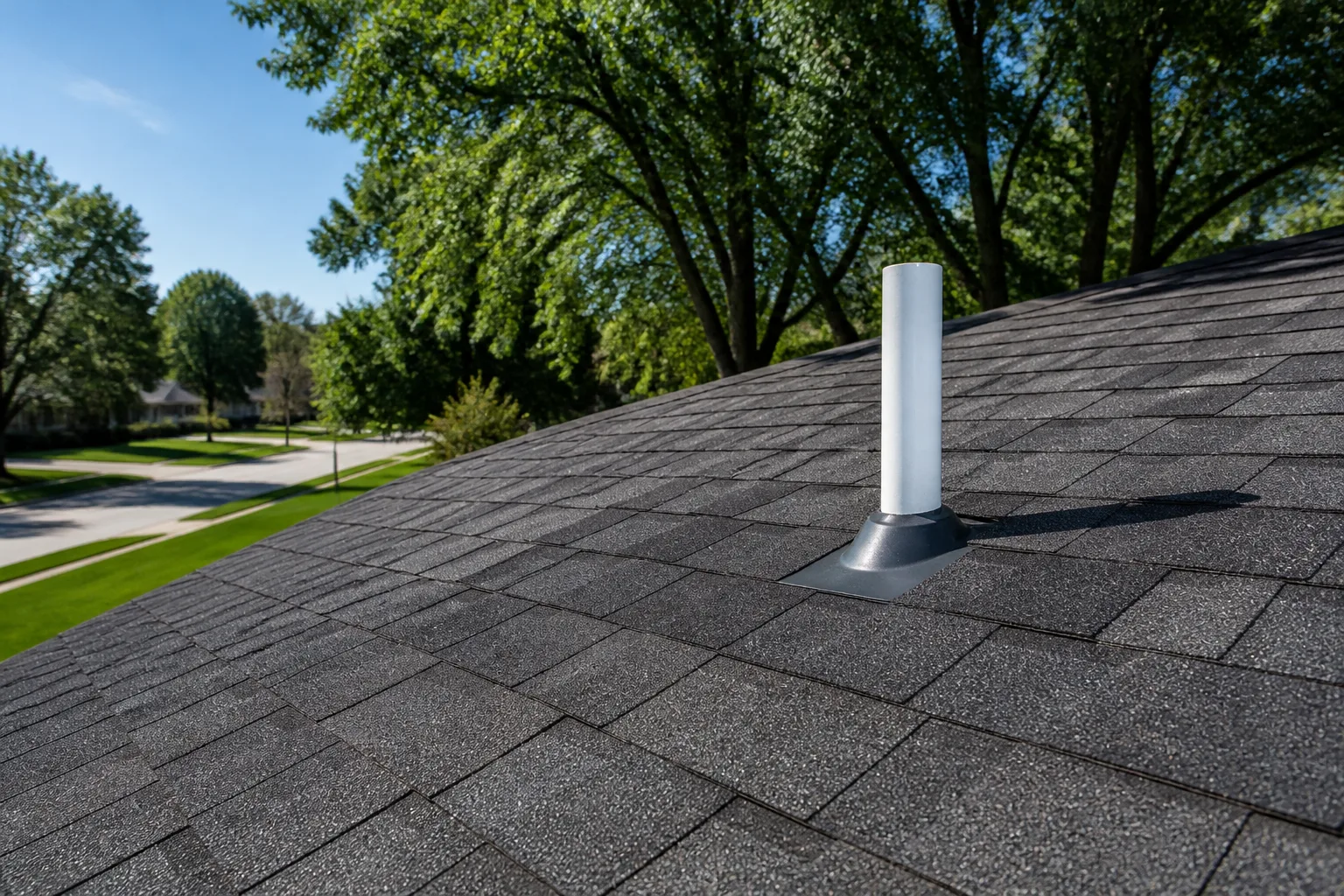
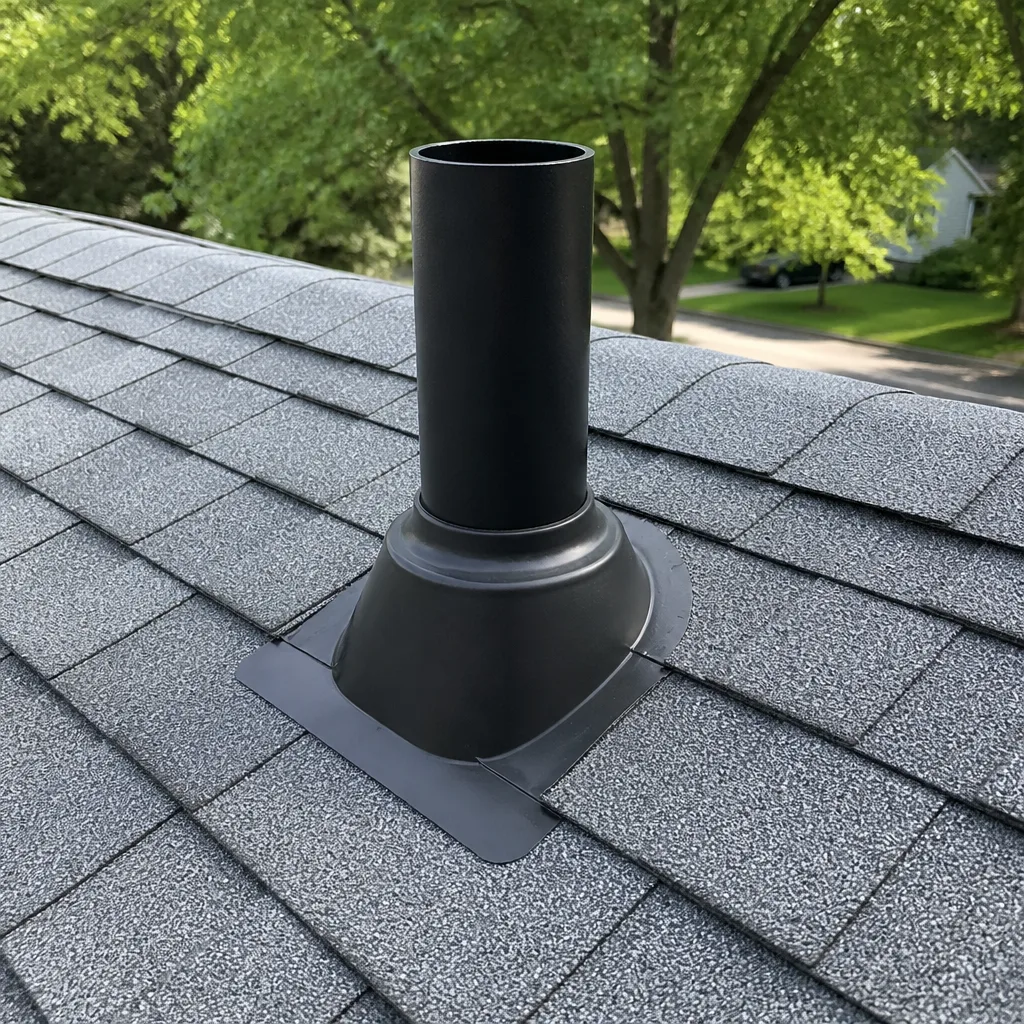
- Cracked or hardened rubber collars on the pipe boot. The rubber boot dries out and splits over time. This is the single most common Tacoma leak source we see on roofs more than ten or fifteen years old.
- Missing or lifted nails around a boot. Every missing nail is a hole.
- Staining on the pipe itself. Water tracking down the outside of a vent pipe often leaves a stain line just below the boot.
- Soft decking around the boot (felt from inside the attic, not from standing on the roof). Soft decking means the leak has been active for a while.
These aren’t problems to solve by climbing up yourself. A wet roof, a ladder, and a spot above the electrical service are a genuinely bad combination, and resealing a boot without understanding why it failed usually leads to a repeat failure in a season. A trained professional can inspect the flashing in a few minutes and tell you whether a local repair is enough or whether the roof detail needs a more thorough fix. If it turns out the whole roof is on its last legs, a roof replacement handles valleys and penetrations as part of a complete system rather than patching symptoms.
A Triage Framework: Monitor, Budget, or Call This Week
Knowing which warning signs mean “watch it” and which mean “call someone this week” saves you both money and stress. Not every sign requires a phone call, and not every sign can afford to wait. The framework below is what we use when we walk a Tacoma roof and try to give a homeowner an honest answer instead of a sales pitch.
Monitor and photograph:
- A single stain that hasn’t darkened across the last two wet seasons.
- Isolated moss growth in one shaded area without visible shingle damage.
- Faint condensation staining without active drip or soaked insulation.
- Slight color variation or sun fade on the shingle surface.
Budget for work this year:
- Granule loss that’s visible as a distinct dark pattern across a slope.
- Cupping or curling limited to one slope or one shaded area.
- Older pipe boots with visible cracking but no active interior sign yet.
- Debris in valleys that you can’t safely clear yourself.
- Aging shingles approaching their typical replacement window (asphalt shingles tend to be quoted in fifteen- to twenty-five-year ranges depending on grade).
Call this week:
- Any interior stain that’s darkening over days.
- Daylight visible through the roof deck from inside the attic.
- Sagging along the roofline.
- Active dripping during rain, even if it’s slow.
- Lifted shingles over a large area, especially before a wind event is forecast.
- Any sign of water intrusion near a chimney, valley, or boot with soaked insulation behind it.
The line in our experience that matters most: if a stain is growing, don’t wait. If it isn’t, you probably have a season to plan. Photograph the same spots every few months so you can see the difference. Call (253) 295-5163 when you’re at the point of wanting a professional read. We answer 24/7. Fast dispatch from 7am to 7pm, Sunday through Friday.
When Warning Signs Mean a Full Roof Assessment
Some warning signs are worth a local repair call. Others mean it’s time to look at the whole roof as a system. The line between the two isn’t always obvious from below. Here’s the simplest rule: if you’re seeing two or more warning signs across different areas of the roof, the reasonable next step is a full assessment rather than a targeted patch. Multiple signs at once usually means the roof is aging as a whole, not failing locally.
A proper Tacoma roof assessment includes looking at the shingle layer, the flashing details, the decking condition under any suspect areas, ventilation, and the roof-to-wall junctions. From that, a good contractor should be able to tell you the remaining life in plain terms, whether any repair will meaningfully extend it, and what your options are if it won’t.
That’s also where getting the material choice right matters. Most Tacoma homes can go several directions when it comes time to replace: an architectural asphalt shingle from Tamko, GAF, or CertainTeed; a tile profile or a metal panel system from Boral, depending on the roof’s geometry and structure. Comparing options side by side, with the same contractor, is more useful than calling three single-brand companies who each recommend what they stock. We carry seven brands across shingle, tile, and metal for exactly that reason. Your roof decision should be driven by your home, not by a warehouse.
Common Mistakes to Avoid
- Treating visible moss with a spray and calling it done. Moss is a symptom of moisture retention, and spraying the surface without addressing what’s causing the retention means it comes back next fall. If you’re treating moss without fixing drainage or debris issues, you’re paying twice for the same problem.
- Assuming a dark ceiling stain is condensation. It might be, but if the stain is darkening over days or following a line, assume it’s an active leak until someone tells you otherwise. The cost of guessing wrong here is much higher than the cost of an inspection.
- Reading granule loss as normal wear. Some granule loss is normal. But a bare patch that’s visibly lighter or darker than the rest of the roof is a granule-loss pattern worth understanding, not a cosmetic quirk.
- Confusing cupping with curling and treating them the same. They indicate different causes and different timelines. Getting this wrong means either an unnecessary replacement or a roof you should have replaced getting patched.
- Waiting for a drip before acting. A drip is a late-stage sign. By the time water is coming through, the decking underneath has usually been wet on and off for a while. Earlier signs, like staining or curled edges, are the ones worth acting on.
- Calling only one branded roofer for a material opinion. If a company installs only one brand or one material, their recommendation will be that brand or material. Comparing across shingle, tile, and metal with the same contractor is more honest.
- Climbing up to check flashing yourself. Every year we hear about a homeowner who tried to reseal a valley in the rain and got hurt. Wet shingles and ladders don’t mix with electrical service running through the roof. Leave it to a professional.
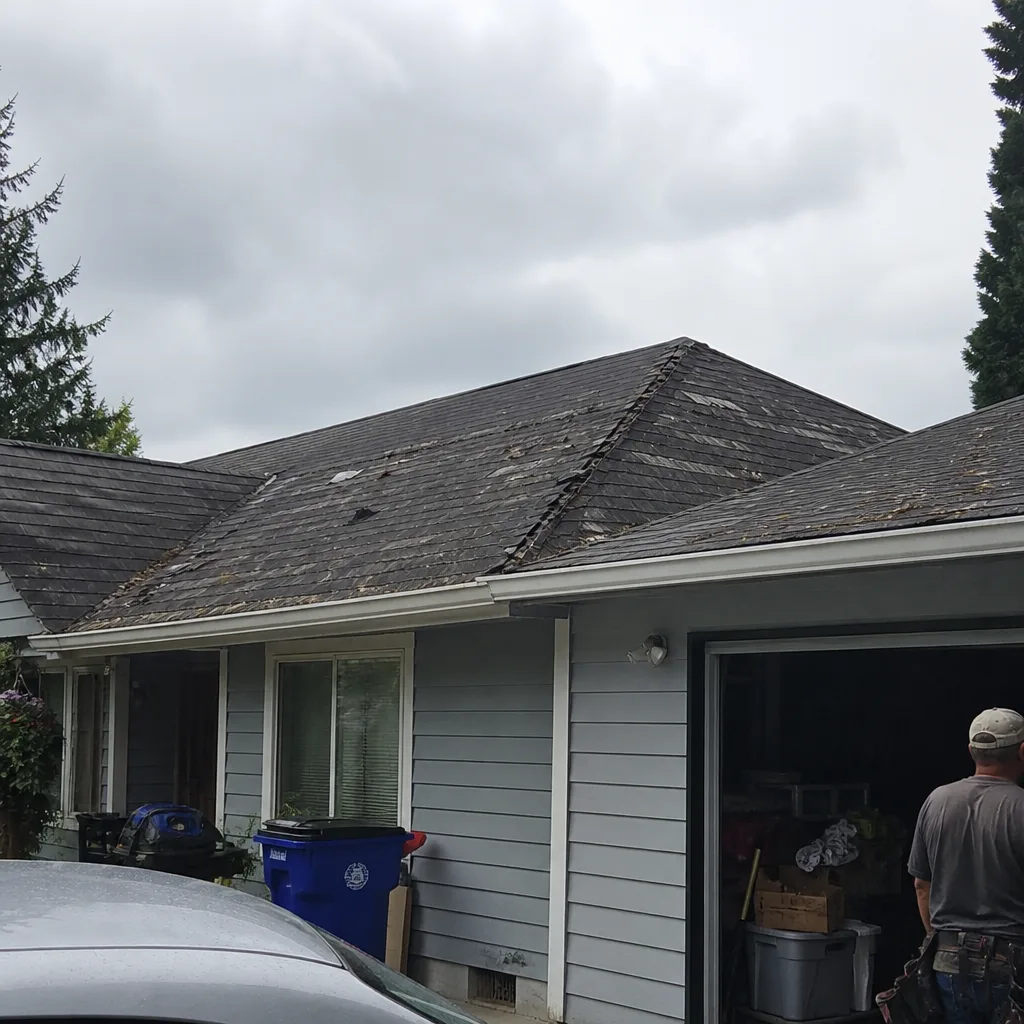
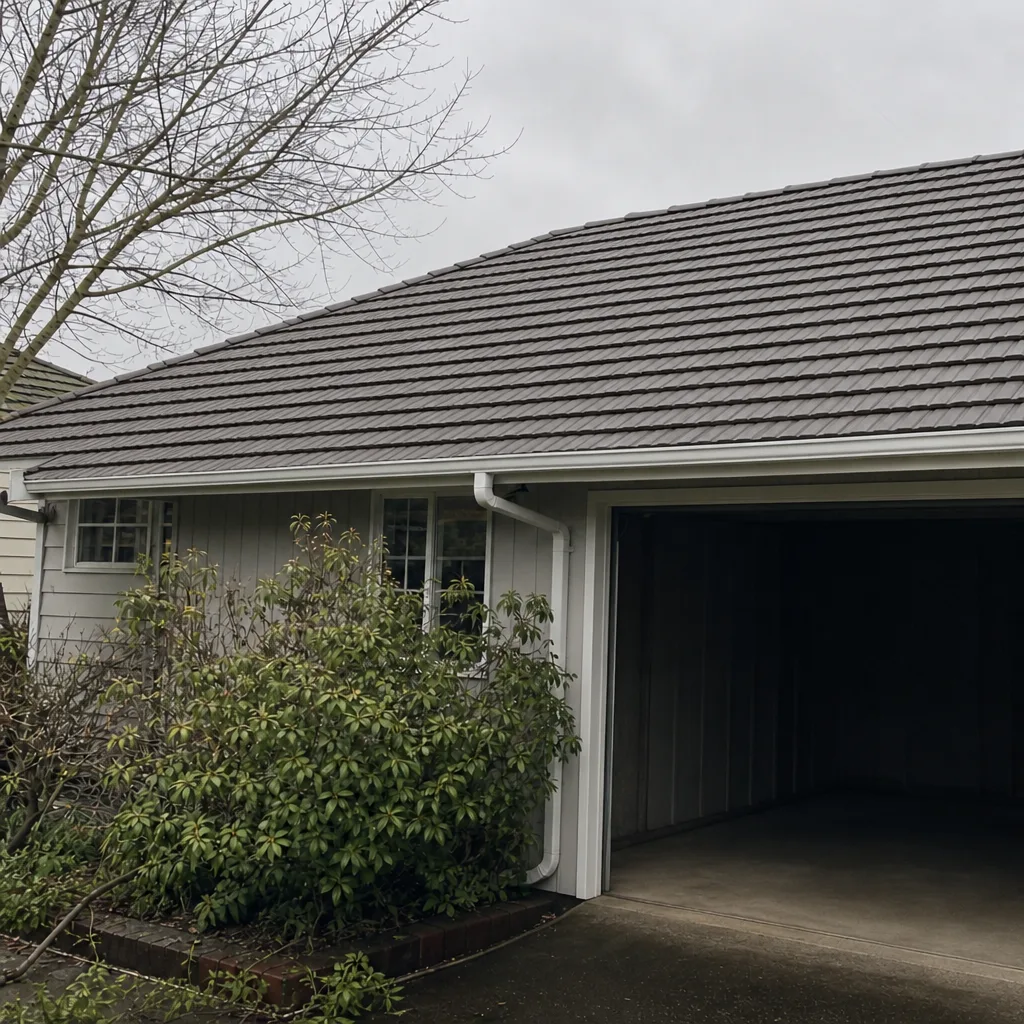
See the difference
 Before
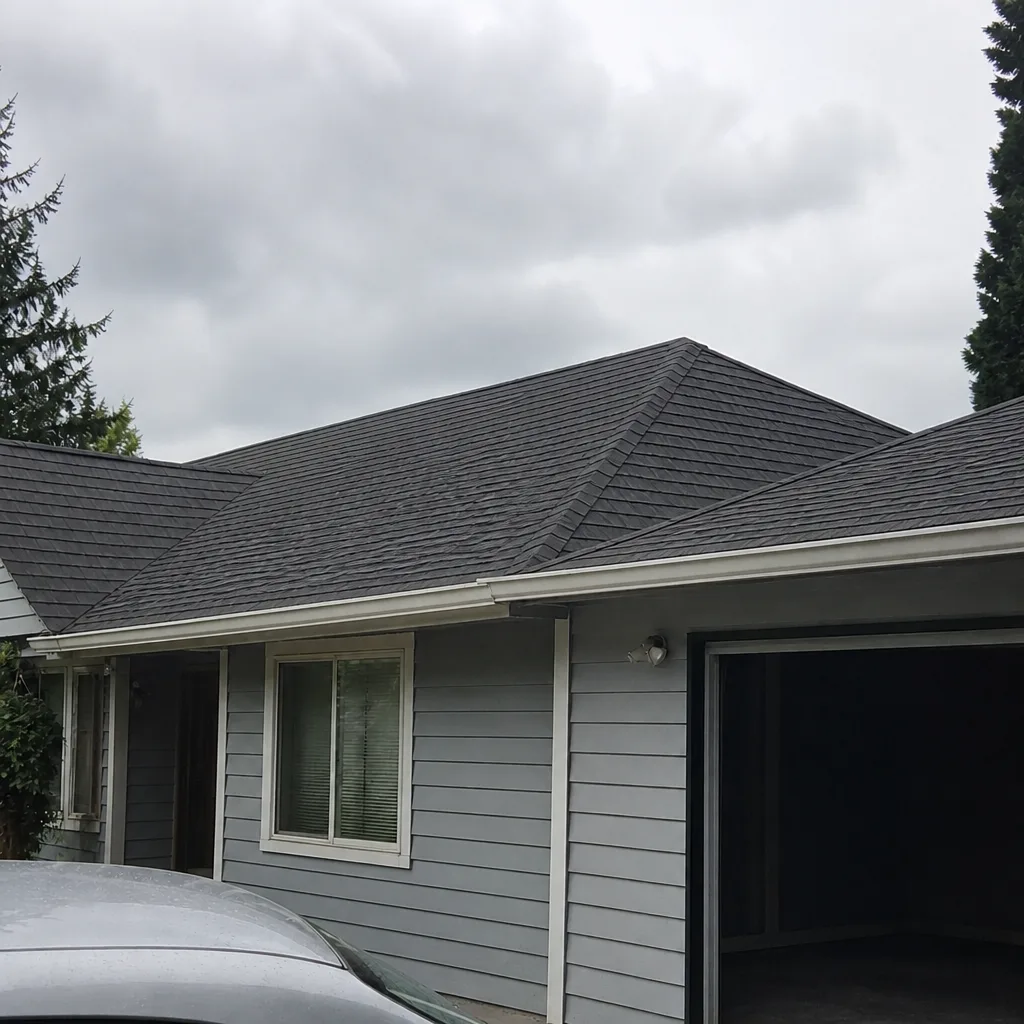 After
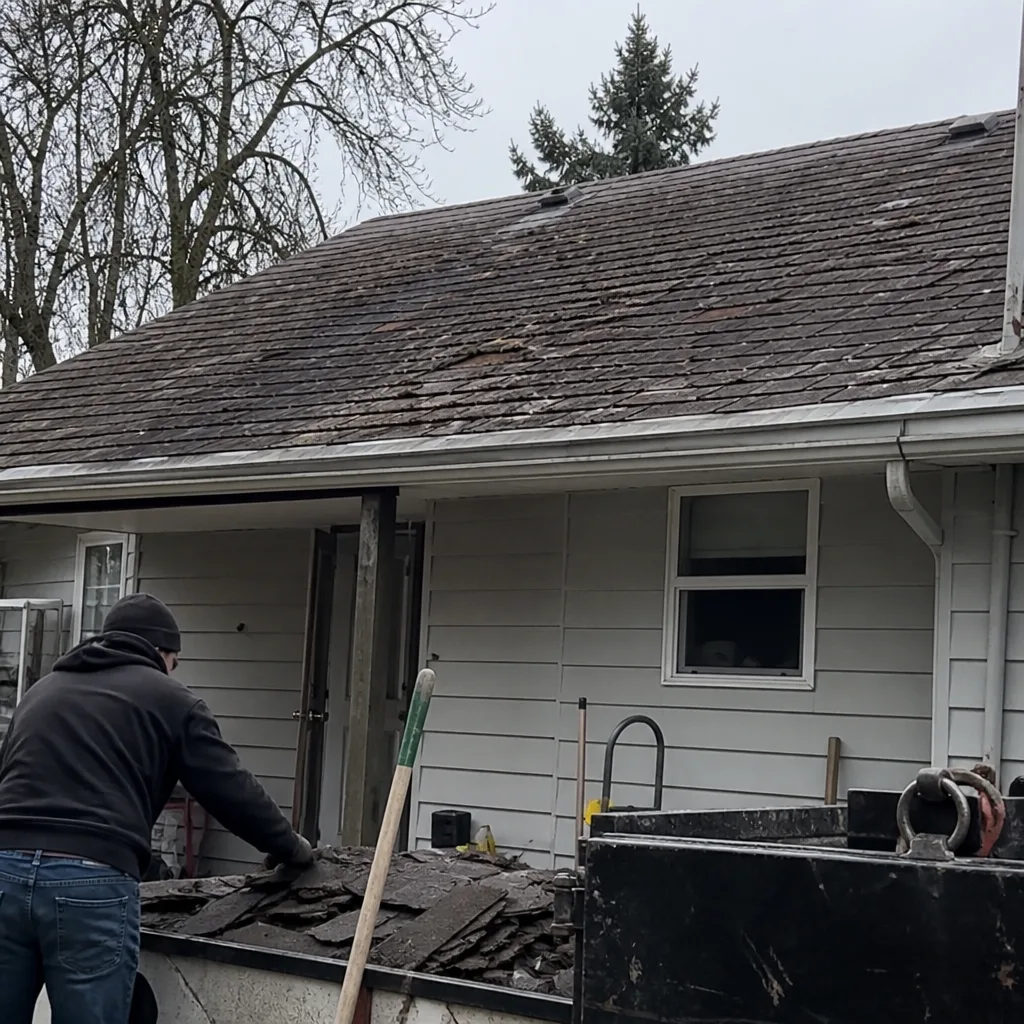 Before
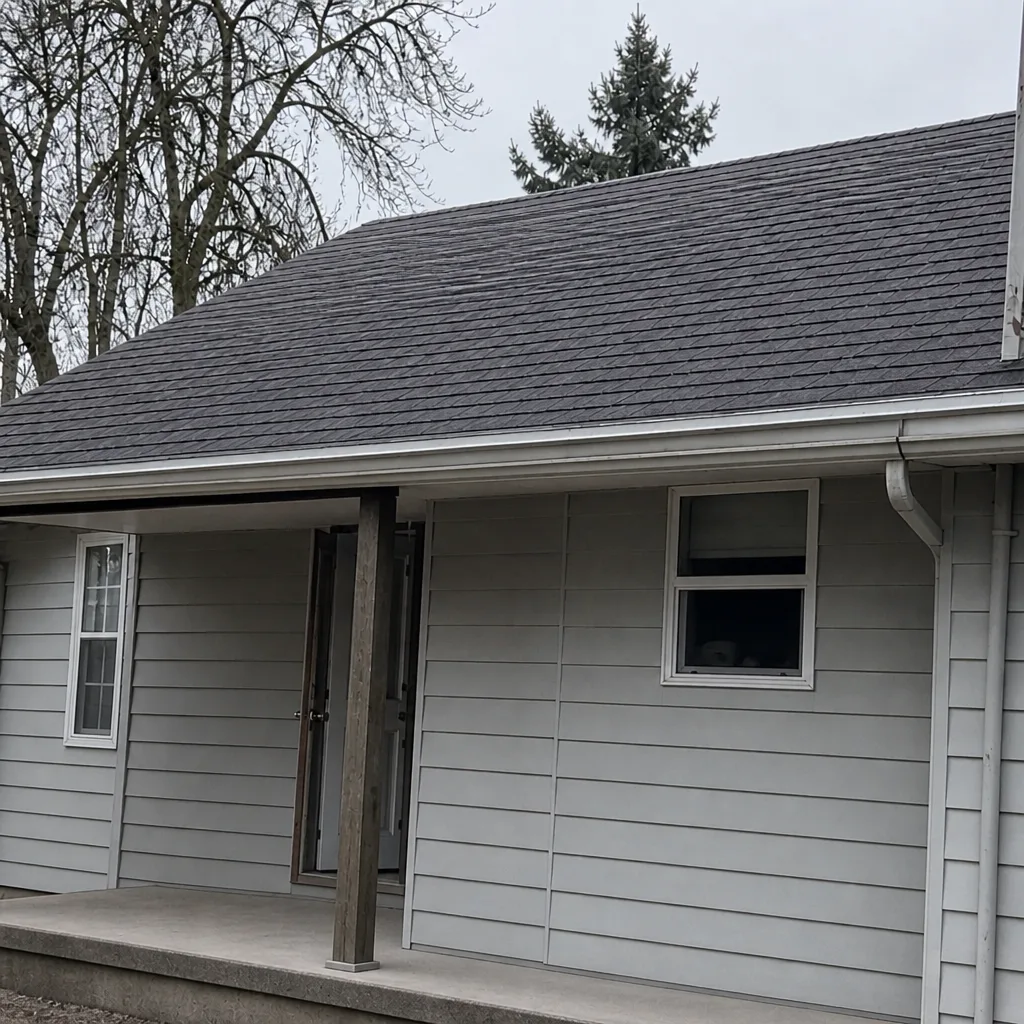 After
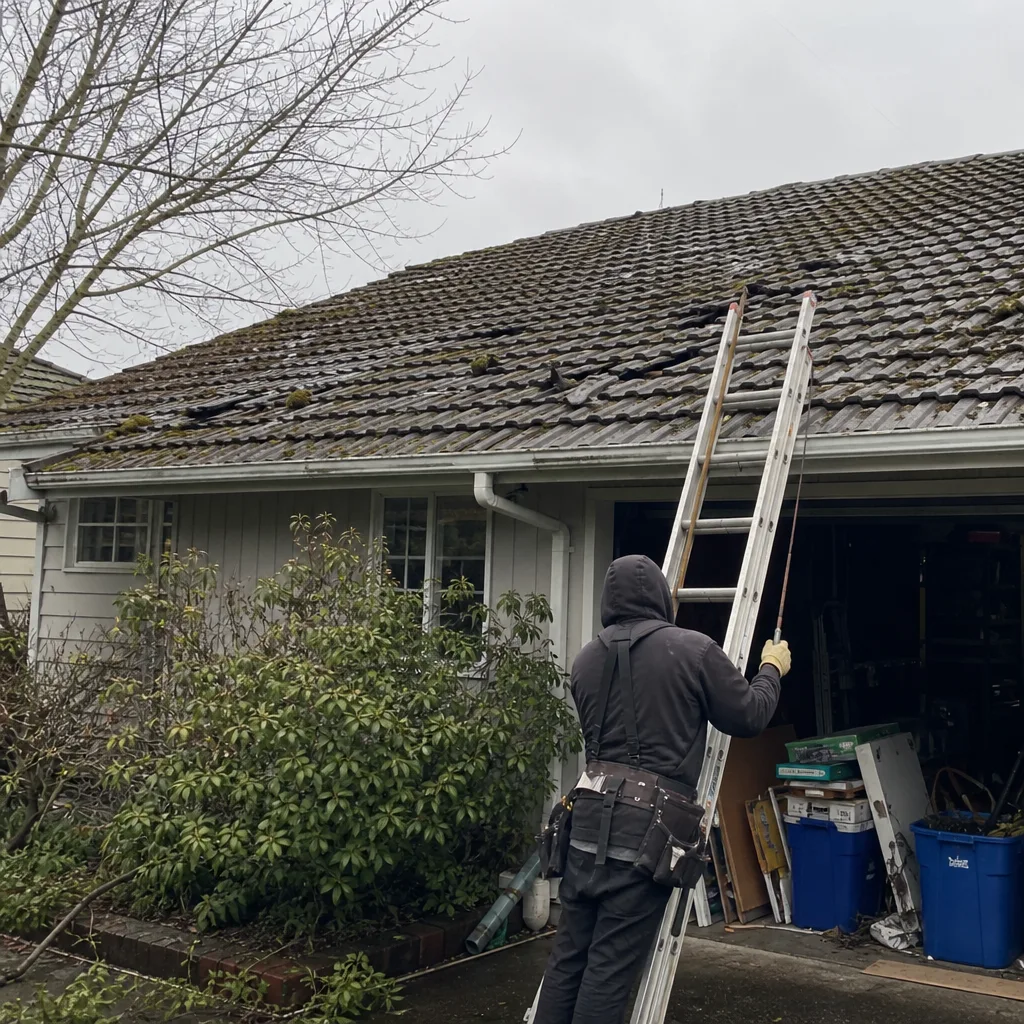 Before
 After
When to Call a Professional
Call a professional if any interior stain is darkening over days, if you see daylight through the roof deck from inside the attic, if any part of the roof sags, if you have soaked insulation behind a ceiling, or if you have two or more warning signs across the roof at once. Call if you don’t want to climb a ladder in Tacoma’s wet season – a lot of homeowners who call us are doing the sensible thing. Call if you have cracking pipe boots and you’re not sure whether a local repair will hold. And call if you’re wondering whether a full replacement is worth it; the honest answer might be “not yet”, but you should hear that from someone who’s looked, not from a guess made off the ground.
Tacoma Roofing Co offers free estimates in Tacoma – call (253) 295-5163. We answer 24/7. Fast dispatch from 7am to 7pm, Sunday through Friday.
Frequently Asked Questions
The most common warning signs we see in Tacoma are granule loss that reads as a dark pattern on the shingle surface, moss growing in valleys or under tree cover, cupping shingles concentrated on shaded slopes, and cracked or hardened pipe boot collars. Interior staining that darkens over days is the sign that should prompt a call, not a wait. Call (253) 295-5163 for a free estimate – estimates are free.
A leak stain grows from a point or a line and darkens over days; condensation staining appears as a faint, uniform discoloration across a wide area, often near the ridge, and usually doesn’t darken after rain. Frost on nail tips in the attic points toward condensation, while soaked insulation and a wet deck point toward an active leak. If you’re unsure, an inspection is fast and worth it. Call (253) 295-5163 for a free estimate.
Yes, though not always for the reason homeowners assume. Moss itself is a symptom of prolonged surface moisture, and the moisture is what shortens roof life. Treating the moss without addressing the drainage, debris, or shading issue that allowed it to establish means it comes back. If the moss extends into shingles that are clearly worn, a professional assessment is worth the time. Call (253) 295-5163 for a free estimate – estimates are free.
Asphalt shingles are typically quoted in fifteen- to twenty-five-year ranges depending on the grade and ventilation, but Tacoma’s damp winters and heavy tree cover often put roofs on the shorter end of that range. Good attic ventilation and regular debris clearing make a meaningful difference. If your roof is in that window and you’re seeing multiple warning signs, it’s worth getting an honest read on remaining life. Call (253) 295-5163 for a free estimate.
We handle both. Small repairs on pipe boots, valleys, or isolated damage are often the right call when the rest of the roof has meaningful life left, and a full replacement makes sense when the roof is aging as a whole. Our estimators can walk you through what a repair will realistically get you versus what a replacement solves. Call (253) 295-5163 for a free estimate – estimates are free.
We install three material categories – asphalt shingle, tile, and metal – and we carry seven brands including GAF, CertainTeed, Owens Corning, IKO, Atlas, Tamko, and Boral. That’s more than a single-brand contractor can offer, and it means your roof can be specified around your home instead of around what a warehouse happens to stock. For a replacement or a new roof installation, call (253) 295-5163 for a free estimate.
The Bottom Line
The warning signs worth your attention on a Tacoma roof are the ones that look subtle from the ground and don’t get noticed until water is inside. Granule patterns, cupping versus curling, moss growth as a moisture map, condensation versus leak staining, and flashing at valleys and pipe boots are the pieces that matter most. If a stain is growing, call this week. If it isn’t, you have room to plan and budget. The rest is honest reading and knowing which of those two situations you’re in. When you’re ready for a professional look, we’re here for it.
Call (253) 295-5163 for a free estimate. We answer 24/7. Fast dispatch from 7am to 7pm, Sunday through Friday.
Written by the team at Tacoma Roofing Co.